
1) Less dependent on outdoor environmental conditions
1) Less dependent on outdoor environmental conditions
A major benefit of a controlled environment in agriculture is that the system is either semi-closed or completely closed. This means that the crops you are growing are less susceptible to external uncontrollable factors such as the amount of sunshine and rainfall. Farming in a controlled environment makes the crops less dependent on the surrounding weather conditions. It then becomes possible to alter the climate and to create an optimum growing condition for the crops. The quantity of crop production will consequently increase as well.
2) Higher quality crops
2) Higher quality crops
The crops that are produced in a protected environment looks better and has less damage due to environmental condition or insects. This helps to sell the produce for a higher market price, and a premium can be asked for greenhouse crops. For example for strawberries.
3) Year round production becomes possible
3) Year round production becomes possible
With the right greenhouse equipments and greenhouse technologies, year round production will be possible; meaning more crops can be harvested per year and multiple growing cycles can take place. If there is a demand or market for a particular crop, and increasing crop production throughout the year can enhance your revenues, then indoor farming should be seriously considered
4) Crops are less exposed to pests & lower pesticide usage
Another benefit of controlled environment agriculture that the crops are well protected from pests such as insects or plant associated diseases. The exposure of crops to pests in an indoor environment will also decrease, resulting in a significant reduction in the usage of chemical pesticides compared to conventional agriculture systems (outdoor production).
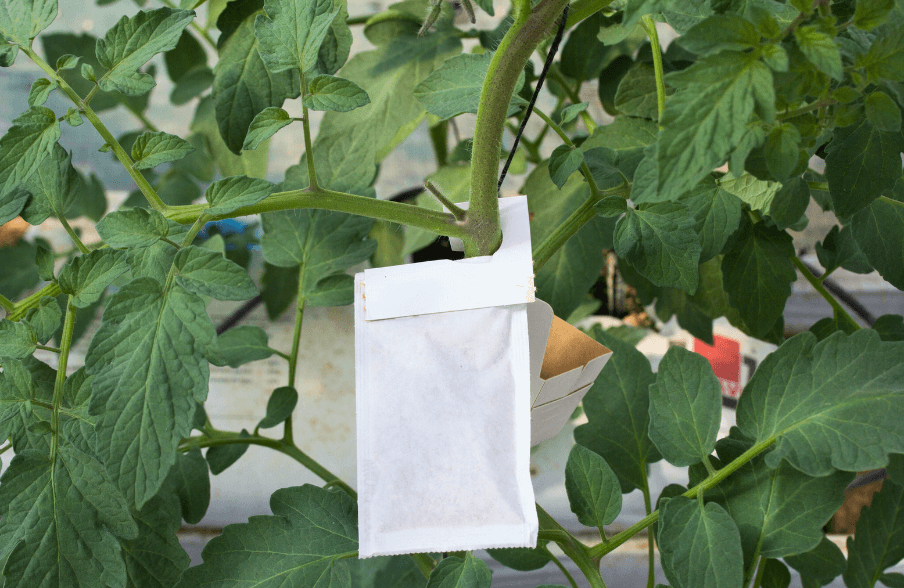
In an indoor environment, the usage of biological control systems is really effective. With biological control systems, natural enemies of a certain pest can be used to eliminate the pest. Little to no chemical pesticides are then needed, which is the case in the Netherlands for the vegetables grown in the commercial greenhouse. Some examples of biological control systems as part of integrated pest management used in the Netherlands:
Predatory Insects:
- Ladybugs (Hippodamia convergens): These beetles are natural predators of aphids and other soft-bodied pests.
- Predatory Mites (Phytoseiulus persimilis): They feed on harmful mites, helping control spider mite populations.
Parasitic Wasps:
- Encarsia formosa: This parasitic wasp targets whiteflies by laying its eggs on them. The emerging wasp larvae then feed on the whitefly nymphs.
5) Significant less nutrient and water usage
5) Significant less nutrient and water usage
Nutrient and water usage will also significantly be lower. Especially when the crops are grown in a hydroponic system (soil-less system), nutrient water can be recycled en recirculated in the system.
Evapotranspiration of water (combination of evaporation + transpiration) stays in the greenhouse (In a plastic greenhouse to a lesser extent than in a glass greenhouse) and returns to the system by condensation.
There is limited evaporation from a closed hydroponic system, as there is nearly no open water service (nutrient water is transported through closed tubes). Therefore, less water to produce the same amount of produce (per kg) is needed comparing to outdoor crop production.
Nutrient loss out of the system will be minimized as well. The nutrient flowing in the system can be recycled until most of it is taken up by the plants (the nutrient water in a commercial greenhouse is sterilized after flowing through the system with UV light).
6) Desert agriculture and production on degraded soil become possible
6) Desert agriculture and production on degraded soil become possible
With controlled environment agriculture combined with soil-less production (growing crops in a water nutrient solution), even desert agriculture or cultivation on degraded soil will be possible.
Even in a desert, it is in principle possible to grow crops and produce food with commercial greenhouses. The climate in the greenhouse is artificially regulated with smart climate control computers, cooling elements (or heating elements to prevent large drop in temperature during the night hours) and humidifiers.
Share this article in 1 click:
About the Author: Yasmin