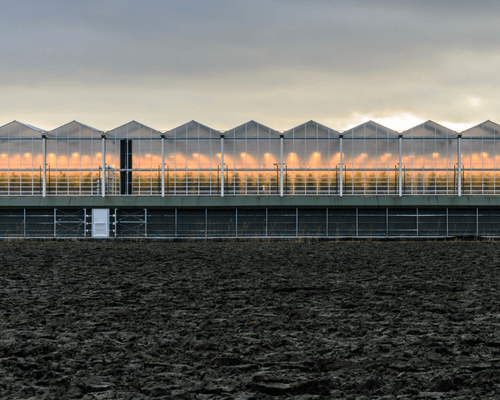
Greenhouses worldwide and their types
Currently, a large amount of the greenhouses worldwide are considered being low-tech. Looking globally, it is estimated that there are approximately 500,000 hectares of land dedicated to protected horticulture (TopsectorTU, 2022).
Among these, 75,000 hectares comprise high-tech greenhouses (15%), with a smaller portion of a few hundred hectares dedicated to Indoor/vertical Farming. Meaning 85% of protected agriculture worldwide is either low-tech or mid-tech. We know that low-tech CEA are plastic tunnels covering the crops. Crops growing in plastic tunnels are only to a small extent protected from the outdoor environment.
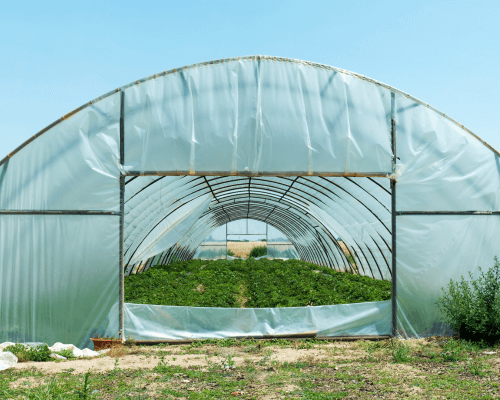
An example of a low-tech greenhouse. Usually, this type of greenhouse is installed in warm countries with the crops growing directly in the soil. The tunnels are open, so there is natural ventilation.
Government investment for local food security:
With food security in mind, more governments are investing in greenhouse horticulture. To produce and provide enough food (vegetables) in their own country without being largely dependent on their neighboring countries for food import.
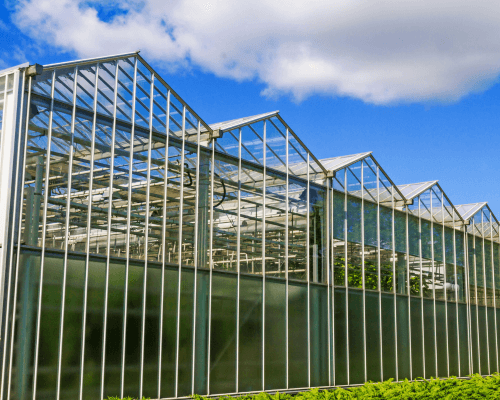
One of the expectations and trends of CEA is that more low-tech and mid-tech greenhouses will start to implement more greenhouse technologies to optimize their productions. The primary goal of controlled environment agriculture has been and will still be focussing on attaining maximum crop yield and produce high-quality fruits while minimizing costs.
Technological advancements in CEA:
Advancements in affordable and energy-efficient sensors, improvements in decision-making computer models with artificial intelligence, mobile applications, combined with existing crop simulation models, and better horticultural engineering to build more suitable greenhouses in complex environments are helping the horticulture industry produce better.
Technological innovations in greenhouse production:
Europe pioneered in greenhouse horticulture and in the future, it will definitely still maintain its leading position in the usage and area coverage of (high-tech) greenhouses. Same with having a thriving cluster of innovative companies and institutions steering this industry.
CEA growth opportunities worldwide:
Besides great growth opportunities and rapid expansion of Controlled Environment Agriculture CEA in the European continent, it is expected that in the coming next years till (and after) 2050, we will see a sign of significant growth opportunities in North America and Asia too.
For high-tech greenhouse expansion, France, Germany, Poland, Morocco, Turkey, USA, Canada, the Gulf region, China, Japan, Uzbekistan, and Kazakhstan emerge as important countries for the next coming years (Horticulture Tomorrow, WUR 2022)
Increasing interests in advanced CEA in Asia:
In Asian countries, where most vegetables are grown under low-tech greenhouses, there will be a steep growth in mid-tech greenhouse expansion. This is driven by the increasing demand for high-quality vegetables from the middle class, who are both able and willing to pay more for good-quality food.
How fast CEA will grow and where new greenhouses will be built, highly depends on the local considerations involving the availability of water, energy, proximity to markets, labor, and capital.
Potentials for low-tech and mid-tech greenhouses worldwide:
Low-tech and mid-tech greenhouses can improve themselves significantly with improvements such as reducing nutrient leakage out of the ‘greenhouse’ system. This could be for example done by recycling the drain water and re-use the nutrient solution after disinfecting it with UV lights.
Also, significant less chemical pesticides can be used when an integrated pest management approach is considered in low-tech and mid-tech CEA. This is an approach where pest management is not solely performed by spraying pesticides, but also implementing biological control elements with natural enemies and installing insect traps (sticky traps)
Copy the link of this article in 1 click:
Related Posts

About the Author: Yasmin