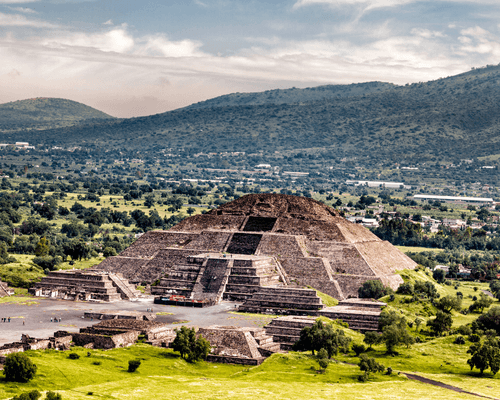
The development of modern hydroponic systems
About 100 years ago (in 1929 to be precise) William Frederick Gericke (1882-1970) was researching a plant-growing system that we know today as hydroponic.
William Frederick Gericke worked at the University of California and was one of the first to experiment with hydroponic growing.
The word “hydroponic” is derived from the Ancient Greek word γεωπονικά (pronounced geoponika), which literally means “of agriculture” or “for agriculture.” The Greek word γαία (earth) was replaced by ὑδρο (hydro) = water, and together they form the word υδρωπονικά (pronounced hydroponika).
The second part of the word relates to ‘labor’. William Frederick Gericke was also the one who introduced the word of hydroponic in 1937.
Later, in 1946, the English scientist W.J. Shalto Douglas introduced the hydroponic system in West Bengal, India.
Starting around 1960-1970, commercial hydroponic farms were established in many countries globally.
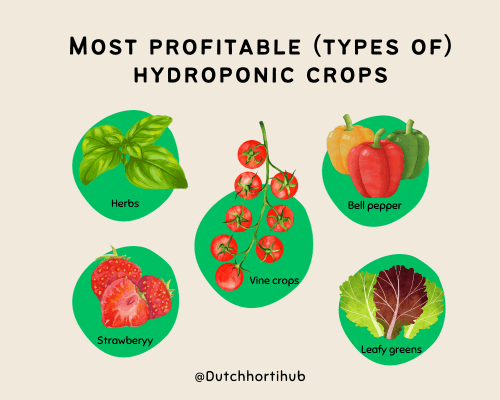
Very often, crops grown in a controlled environment agriculture system are those that can be sold for a higher market price (cash crops) or crops that need to appear as “clean.”
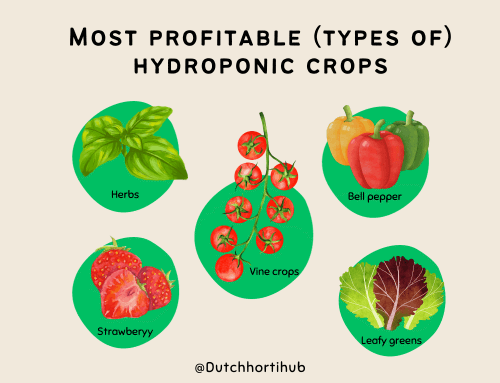
Some examples of greenhouse horticulture crops include:
- Lettuce
- Tomatoes
- Bell pepper
- Strawberries
- Medicinal Cannabis
Some other major products of controlled environment agriculture, of which many consumers are not aware, include mushrooms, insects (for protein production), and fish (aquaponics).
Early hydroponic systems: Aztec floating garden of 9000 ha in Mexico
The greenhouse hydroponics that we know today can be traced back to the Aztec civilization (1345 AD and 1521 AD). The Aztecs, present in central Mexico, were already building floating structures with crops using the same principles as modern hydroponics. Aztec agriculture was ahead of other civilizations in the world at the time.
Tenochtitlan, the city-state where the Aztecs lived, was an island, making it difficult to obtain new agricultural land.
They discovered and implemented an efficient hydro grow system that formed the floating gardens in Mexico City. This system was so efficient that the Aztecs were able to feed their population of 11 million people.
The hydro grow system consists of chinampas. A chinampa is a floating reed plate on water with dimensions of approximately 50 cm x 150 cm. The Aztecs could grow crops efficiently on this. By growing on water, irrigating the crops was no longer a problem.
This allowed them to harvest crops up to four times a year. The covered area with these Chinampas is estimated to be 9000-10000 ha! The fishes in the canals enriched the soil with nutrients of the feces.
Copy the link of this article in 1 click:
Related Posts

About the Author: Yasmin