
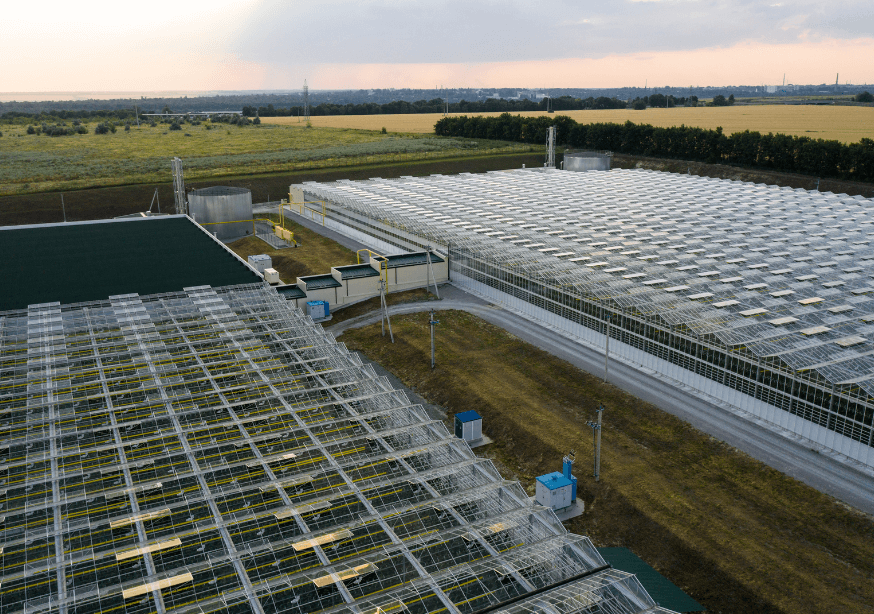
A major difficulty that many greenhouse growers face is to control the heat in the greenhouse. Did you know that it is significantly more difficult to cool down the growing facility than to heat up? Determining the appropriate cooling strategy for a greenhouse is essential for assessing the profitability of the greenhouse project and making informed decisions about its design and construction.
Temperature is an important environmental factor in greenhouses to control, as it significantly influences the growth and development of crops (Hatfield & Prueger, 2015). Controlling and optimising greenhouse temperature is therefore essential to ensure high productivity year round.
How to develop the right cooling strategy for the greenhouse?
Determining the right cooling strategy depends largely on the time of the year and the latitude of the greenhouse (Chou et al., 2004), as the location determines the amount of radiation (heat) entering the greenhouse and the level of humidity.
Determining the appropriate cooling strategy for a greenhouse is essential for assessing the profitability of the greenhouse project and making informed decisions about its design and construction.
Passive v.s active cooling
Cooling strategies may generally be classified into two categories: 1) passive cooling, in which the cooling system does not use energy to cool the greenhouse, or 2) active cooling, where in some way energy is used to cool the greenhouse. Often, being able to manage cooling is a basic necessity for greenhouse crop production to overcome unavoidable high temperatures during summer months.
Options of passive cooling
Important passive cooling options include natural ventilation (to facilitate air exchange and prevent heat build-up), shading with (energy) screens, and chalk applications to avoid too much irradiation into the greenhouse. Although these passive cooling strategies require little or no external energy input, their cooling potential is limited. In particular, natural ventilation generally cannot reduce the greenhouse air temperature below the outdoor air temperature under typical daytime conditions.
Options of active cooling
If the greenhouse air temperature needs to be (significantly) lower than the outside temperature, active cooling is required. Active cooling can be achieved through evaporative cooling, utilizing misting systems or wettable cooling pads (with or without fans). The transformation of liquid water into water vapour absorbs heat energy from the surroundings, thereby lowering the ambient temperature. Some growers also employ roof cooling, where (cold) water is sprayed on the greenhouse roof to cool a large area. Mechanical cooling, including fans and specialized air conditioning (Li, 2015), is also considered a form of active cooling.
Mild & cold climate conditions
The simplest climate to control is when the 24-hour temperature throughout the year is around 19-21°C or lower. In such cases, cooling to reduce heat is generally not needed except during the hot summer period. Cooling in this type of climate is mostly achieved through natural ventilation by opening and closing the greenhouse windows for airflow. To prevent heat buildup in the summer, some (more wealthy) growers additionally use screens, misting, and wet pads with fans (to prevent carbon dioxide loss to the environment due to opening of the greenhouse window).
Hot climate with low humidity level
When the 24-hour average temperature is higher than 19-21°C and the surrounding humidity level is low (= a hot, dry climate), relying solely on opening windows for passive cooling as the main strategy is no longer sufficient. The temperature difference between inside and outside would be too small to efficiently reduce the temperature. The most effective cooling strategy, in this case, is to utilize evaporative cooling with misting and/or pad wall cooling. A high-tech, semi-closed modular greenhouse would be necessary for this type of active cooling to prevent energy loss. Cooling to lower the temperature is frequently done in the evening, as bringing the temperature down in the dark is easier and consumes less energy. Because most plants work with temperature integration, fluctuation in day and night temperatures is generally not a huge problem
Hot climate with high humidity level ( = expensive in cooling)
But how do you control cooling when the 24-hour temperature average is higher than 19-21°C, and there is also high relative humidity? In this hot and humid climate, where day temperatures often exceed 28°C, evaporative cooling becomes ineffective because the surrounding relative humidity is too high for water droplets to evaporate and utilize the surrounding energy to cool down the environment. In such a situation, day and night active mechanical cooling is necessary, using fans or air conditioning units with a higher cooling capacity (around 450W/m2).
Some closing words
With rising temperatures worldwide due to climate change, both new and existing greenhouses will need to consider adding additional cooling infrastructures to protect the crops from heat stress.
Sources:
Chou, S. K., Chua, K. J., Ho, J. C., & Ooi, C. L. (2004). On the study of an energy-efficient greenhouse for heating, cooling and dehumidification applications. Applied energy, 77(4), 355-373.
Hatfield, J. L., & Prueger, J. H. (2015). Temperature extremes: Effect on plant growth and development. Weather and climate extremes, 10, 4-10.
Li, H. (2015). Technology and studies for greenhouse cooling. World Journal of Engineering and Technology, 3(03), 73.
Stanghellini, C., Van’t Ooster, B., & Heuvelink, E. (2019). Greenhouse horticulture: Technology for optimal crop production. In Greenhouse horticulture. Wageningen Academic.
Copy the link of this article in 1 click:
About the Author: Yasmin