Controlled Environment Agriculture (CEA)
Controlled Environment Agriculture offers year-round crop production or season extension, increased resource efficiency, enhanced pest and disease management, and improved crop quality. These are some reasons why outdoor growers switch to indoor crop production in greenhouses. Learn more about controlled environment agriculture below, including available solutions to increase the profitability and production of greenhouses.
What is controlled environment agriculture?
Controlled environment agriculture (CEA) is a way of farming which makes it possible to control the environment in which the crops are grown. The controlled environment definition relates to the fact that the way of indoor farming the crops are less dependent on the surrounding environmental conditions.
In the case of CEA, the crops are grown in a protected environment (covered by structures like plastic, glass or other materials) – this is the reason why controlled environment agriculture is also called “indoor farming” or “indoor agriculture”.
With Controlled Environment Agriculture, the greenhouse grower has more control on the growing condition. Besides that, the amount of the input/resources that is needed to produce a certain amount of crop, can be predicted quite exactly at the beginning of the growing season.
Types of controlled Environment Agriculture & options of Indoor farming
There are different types of indoor farming practices. The system is considered being “controlled environment agriculture”, when the crops that are being grown are in some way protected from the environment by a glasshouse or a plastic structure.
A CEA system can range from very simple (in the case that the crops are only covered by a plastic greenhouse structure (low-tech)), to more complex, such as growing crops in glass greenhouses with additional artificial lighting. The most protected type of indoor farming is when the crops are totally secluded from the environment and not dependent on any uncontrollable environment condition.
Low-tech
Tincidunt amet viverra orciat morbisya praesent.
Mid-tech
Tincidunt amet viverra orciat morbisya praesent.
High-tech
Tincidunt amet viverra orciat morbisya praesent.
The most advanced and most high-tech indoor farming system, is in a vertical farming setting. Here, the crops are illuminated with artificial lighting (often LED plant growth lights) and there is a total climate control. Each variable of the growing condition can then be controlled. Growing crops in a vertical farming setting is also the most expensive way of growing the plants, as the energy from the sun to drive photosynthesis is not directly used in this system.
A misconception exists regarding Controlled Environment Agriculture (CEA), wherein it is commonly assumed that crops are exclusively cultivated in vertical farms. However, this assumption is inaccurate. CEA is more than just producing crops in a vertical farm.
Within CEA agriculture, we define the indoor growing system as either low-tech, mid-tech or high-tech. The level of the ability to control the environment increases when you go from a low-tech CEA system to a mid-tech CEA system. With high-tech CEA system having the highest level of human/artificial control of the system.
What is Low-Tech greenhouse horticulture?
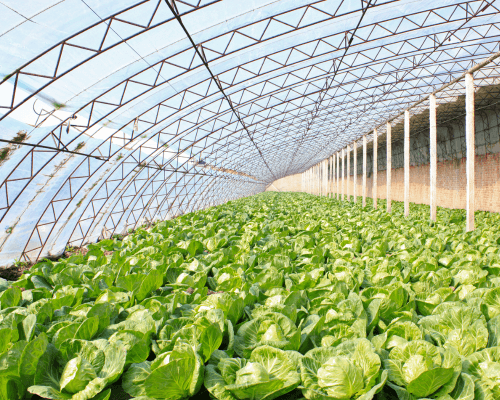
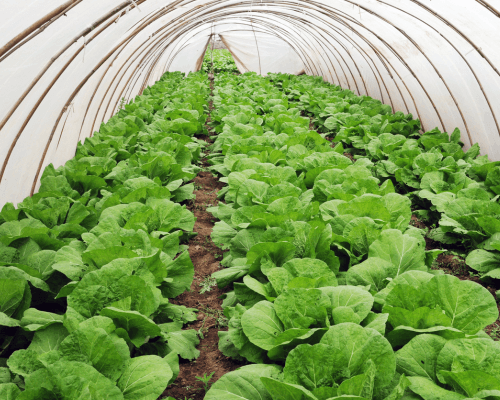
An example of a low-tech greenhouse. The wall on the right warms up during the day and releases heat in the greenhouse in the evening. Low tech greenhouses are often covered by plastic and there are openings in the tunnels for airflow.
A low-tech greenhouse is a simplified structure designed for basic horticultural needs. It typically features natural ventilation and relies on manual controls. While cost-effective (it is not so expensive to build a low-tech greenhouse), it offers limited automation and environmental control compared to more advanced options.
Also, the protection layer of a low-tech greenhouse is made from plastic. This needs to be changed quite often and year-round prodution is not guaranteed.
This type of controlled environment farming system is normally found in tropical or warm area’s in the world (Asia or Africa).
The production is the lowest in a low-tech indoor farming setting, compared to mid- or high-tech indoor farming.
Some challenges related to low-tech greenhouses:
- Inconsistent
product quality - Higher distribution costs
- Less-experienced
management - Less-developed infrastructure
- Lower Energy Use Efficiency
What is Mid-Tech Greenhouse horticulture?
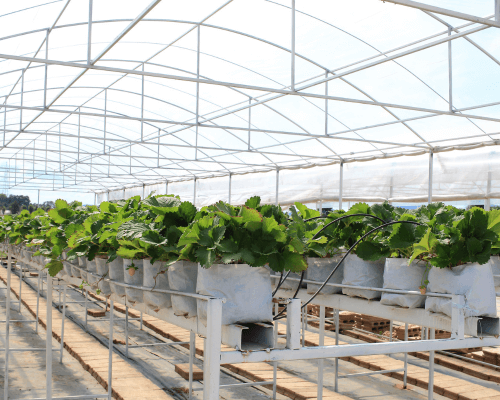
An example of a mid-tech greenhouse. The strawberries are growing in bags with automated drip-irrigation.
A mid-tech greenhouse incorporates moderate automation and environmental control systems. It may include technologies such as automated ventilation, basic climate control, and irrigation. Sometimes, artificial lightning (supplementary lightning) is also present.
This level of technology enhances efficiency and crop management without the complexity of high-tech solutions.
The crops growing in a mid-tech greenhouses look better compared to low-tech greenhouses. Also, there are less issues with pests. However, the level of automation can still be increases (not manually turning lights on and off) which can save labor costs.
What is High-Tech Greenhouse horticulture?
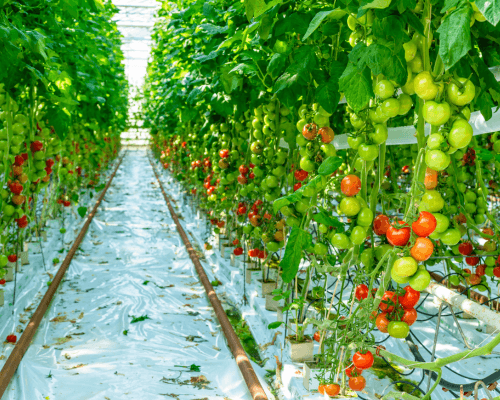
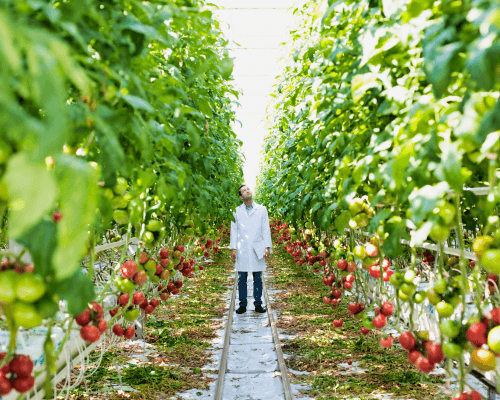
An example of a high tech greenhouse where tomatoes are grown. In these modern greenhouses, automated process help the growers to produce better crops. Also, a lot of decisions are made based on data.
High-tech greenhouses are equipped with advanced technologies for precise environmental control. Also, (active) heating and cooling elements are present.
Automated systems regulate temperature, lighting, humidity, irrigation, and nutrient delivery (through a hydroponic system). There is often also a nutrient water disinfection system with UV lights to clean the drain water.
With high-tech Greenhouse agriculture, it is possible to grow without chemical pesticides. In these modern high-tech greenhouses, natural enemies of the pests (e.g. insects) are used to control the pest population.
Large scale automated greenhouses with seeding machines or harvesting machines (in the case of growing lettuces) can be installed in high-tech greenhouses.
In this type of greenhouse, there are sensors and computerized management to optimize growing conditions (data-driven method to make good decisions). This leads to enhanced crop yield, quality, and resource efficiency.
Most high-tech greenhouses worldwide can be found in European countries (the greenhouse industry is well developed in the Netherlands) and in Canada.
Description of Indoor Farming with vertical farming:
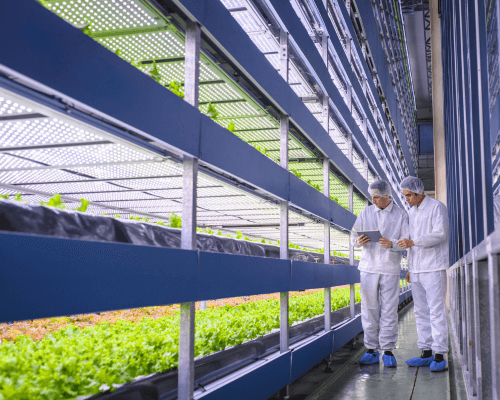
Vertical grow systems, like growing crops in a vertical farming setting, use multiple farming technologies to increase the overall yield per growing area. Crops are then being grown in a very clean environment with often no need of pesticides at all. Growing leafy greens (which has a very short growing cycle) is one of the most profitable crops to grow in a vertical farm.
Vertical farming involves growing crops without any sunlight at all, but uses artificial plant growth lighting such as LED lights to illuminate the crops. The crops are often stacked in layers (like warehouse shelves) or vertically inclined surfaces.
The indoor environment in a vertical farming setting, is nearly 100% controllable. This is done with advanced greenhouse technologies, including LED lighting, hydroponic or aeroponic systems, climate control with healting/cooling elements. People walk around in clean suits to prevent the spread of plant diseases.
Unlike traditional high-tech greenhouses, vertical farming tries to maximize space by growing crops vertically, above one another. More crops can be harvested per ground area in a vertical farming setting.
Also, in traditional high-tech greenhouses, sunlight is still used to drive plant photosynthesis. But in a vertical farming setting, the only light source for the plants come from lights.
Increasing the energy use efficiency in greenhouses is one of the important topics to work on to increase the long term profitability of vertical farms.
Why to grow crops in a controlled environment?
There are some important benefits regarding growing crops in a protected environment:
With the increasing unpredictable level of climate change effects on rainfall, temperature and extended periods of flooding and droughts, steady predictable amount of yields is harder to achieve.
In the next coming 50 years, the level of unpredictable weather conditions will only be increasing and the amount of farmable land in the world will decrease due to soil erosion and land degradation.
This is a concern, particularly in light of the projected global population reaching 9.3 billion by 2050. Ensuring universal access to an adequate food supply is regarded as a fundamental human right, making this issue particularly pressing.
One of the potential options to ensure food security and to meet future food demands worldwide is the usage of controlled environment agriculture.
Another challenge the world faces is that our current agricultural activities account for 21–37% of all greenhouse gas emissions each year (IPCC). Therefore, effectively and efficiently utilizing our natural resources while maintaining a low carbon footprint in agriculture is crucial. Growing crops in a protected environment, where resources can be used in a more controlled way and where resource recycling is sometimes possible, can contribute to achieving this goal.
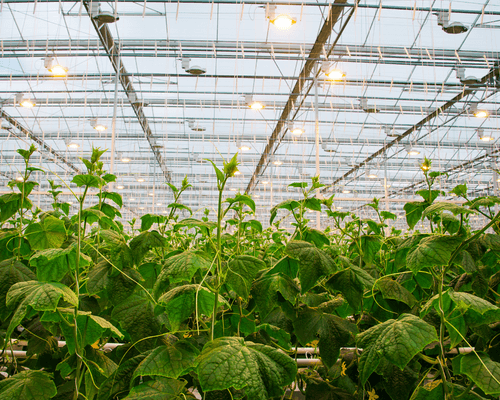
What types of crops are grown in CEA Systems (Indoor Controlled Environments)?
Very often, crops grown in a controlled environment agriculture system are those that can be sold for a higher market price (cash crops) or crops that need to appear as “clean.” Some examples of greenhouse horticulture crops include:
- Lettuce
- Tomatoes
- Bell pepper
- Strawberries
- Medicinal Cannabis
Some other major products of controlled environment agriculture, of which many consumers are not aware, include mushrooms, insects (for protein production), and fish (aquaponics).
What do you need for Controlled Environment Agriculture?
With CEA, climate control farming is an important element. The highest yields are associated with large-scale, high-tech commercial operations primarily located in northwestern Europe, Canada, and Australia. Production in plastic greenhouses using more traditional methods, small-scale operations, and/or soil cultivation results in lower yields.
High-tech greenhouses are made of steel and covered with glass, equipped with complex climate control systems for heating, cooling, humidity and lighting.
To create a better and more optimal growing condition for the crops than outdoor conditions, the following elements are crucial, especially when there is interest for mid-tech or high-tech greenhouse crop production:
- Covering material (plastic or glass)
- Artificial lighting (supplemental lighting)
- Heating elements / cooling elements
- Growing substrate (soil less production)
- Nutrient solution (soil less production)
- Additional CO2 injection
- Climate computer / climate control system
→ Heating needed?
The shift from growing crops on soil in a greenhouse without heating to growing crops in a nutrient solution with heating in a greenhouse, can increase the controllability of the indoor growing system and yield. When looking at tomatoes in heated commercial greenhouses in (European) regions, the yield varies from around 16 to 70 kg/m2, while in unheated greenhouses, the yields range from 11 to 25 kg/m2.